
MindCode
JOURNAL
There is a kind of fatigue that does not seem to follow effort in any recognizable way, and that is precisely what makes it difficult to understand when it appears, because it does not correspond to the usual expectations we have about how and why we become tired.
You reach the end of a day where nothing particularly demanding seems to have taken place, where no major task was completed, no extended period of concentration was required, and no obvious source of strain is easy to identify, and yet the experience is unmistakable: a sense of mental heaviness, reduced clarity, and a kind of exhaustion that feels out of proportion to what was actually done.
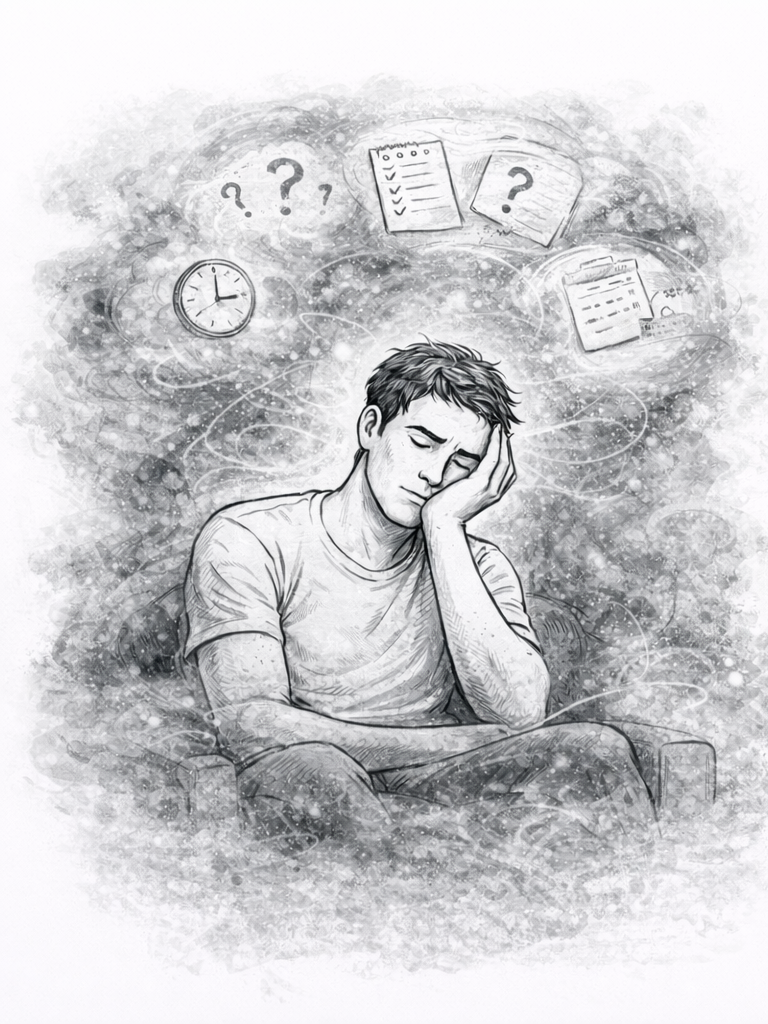
What makes this experience confusing is not just the fatigue itself, but the absence of a clear cause that would normally justify it, which often leads to the assumption that something is off or that the fatigue is not entirely valid.
But the absence of visible effort does not mean the absence of mental activity.
And mental activity, even when it is not obvious, has a cost.
We tend to associate fatigue with visible and measurable forms of effort, such as long hours of work, sustained concentration, or physical exertion, because these are the conditions that make effort apparent and therefore easier to connect with the feeling of being tired.
However, mental fatigue does not always follow this linear pattern, and in many cases, it develops in the absence of clearly defined external demands, which makes it more difficult to recognize and more likely to be misunderstood.
The key issue is that activity is not limited to what can be observed from the outside.
The mind can remain highly active even when the body is still, and this activity can take forms that are fragmented, indirect, and continuous rather than intense and focused, making it less noticeable but not less impactful.
In other words, you can feel mentally exhausted not because you did too much in a visible sense, but because your mind did not stop working in the background.
One of the primary mechanisms behind this kind of fatigue is what can be described as background cognitive processing, which refers to the way the mind continues to engage with unresolved thoughts, pending tasks, social interactions, and future concerns even when you are not actively focusing on them.
This type of processing does not require deliberate attention, and it often operates below the level of conscious awareness, but it still consumes cognitive resources because the brain remains engaged with what has not been resolved.
This can include things like unfinished decisions, conversations that were not fully processed, expectations about upcoming responsibilities, and subtle emotional tensions that have not been clearly identified but are nevertheless present.
Each of these elements may appear minor when considered individually, but collectively they create a continuous stream of low-level cognitive activity that prevents the system from fully disengaging.
This system becomes clearer when you see how different forms of mental load interact:
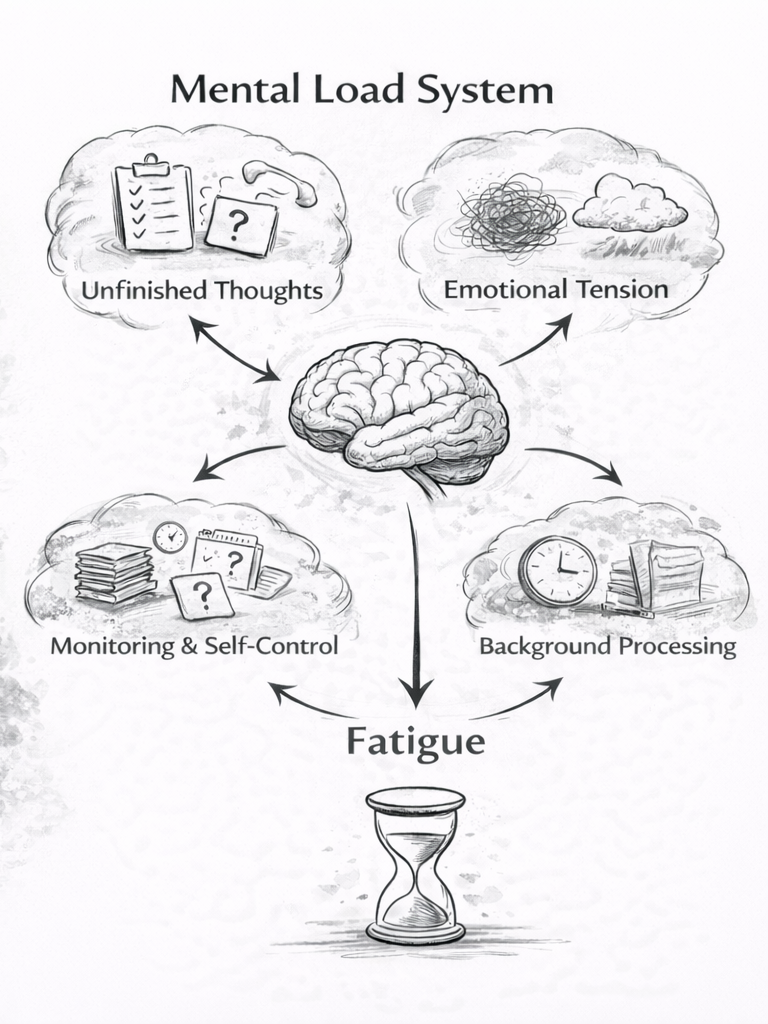
And over time, that continuous engagement accumulates into fatigue.
Mental fatigue is not only a result of doing too much in an observable way, but also a result of holding too much in mind for extended periods of time, especially when that mental content remains unresolved or open-ended.
Research on cognitive load suggests that sustained mental processing, even in the absence of overt behavior, is sufficient to produce fatigue, because the brain continues to allocate resources to maintaining, updating, and evaluating information over time.
This means that thinking, anticipating, monitoring, remembering, and revisiting concerns all contribute to energy depletion, even if they do not translate into visible action.
You can feel exhausted not because you acted, but because your mind did not stop engaging with what it was holding.
Much of this fatigue emerges from a state of constant low-level activation, where there is no single task that demands attention, but also no period of true mental rest that allows the system to recover.
Attention moves from one small element to another—an incoming message, a passing thought, a minor concern, a reminder of something unfinished—without any of these becoming dominant enough to fully occupy the mind, but also without disappearing completely.
This creates a fragmented pattern of engagement, where the brain remains partially active across multiple domains without ever fully disengaging from any of them.
And while each individual element may seem insignificant, their continuous presence creates a cumulative effect that leads to fatigue over time.
One of the reasons this type of fatigue is difficult to resolve is that it is often accompanied by the assumption that doing less should automatically lead to feeling more rested, which is not necessarily the case when mental activity continues in the background.
Rest, for the cognitive system, is not simply the absence of external activity, but the reduction of internal demand, and if that demand remains present in the form of ongoing processing, evaluation, or anticipation, the system does not fully recover.
This is why activities that appear restful, such as scrolling, casually checking things, or allowing the mind to wander around unresolved concerns, do not always restore energy, because they maintain a level of engagement that interrupts true disengagement.
You are not fully working, but you are not fully resting either.
And that in-between state is often where fatigue accumulates.
Another important contributor to this experience is the accumulation of small, often unnoticed decisions that occur throughout the day, each of which requires a degree of cognitive effort even if it does not feel significant in isolation.
Every day involves numerous micro-decisions about what to respond to, what to prioritize, what to ignore, what to delay, and how to allocate attention across competing demands, and while each of these decisions may seem trivial, their cumulative effect is substantial.
The brain continuously evaluates options, weighs potential outcomes, and adjusts behavior accordingly, and this ongoing process consumes energy even when it is not consciously recognized.
As a result, you may reach a point of fatigue without being able to identify a specific source, because the effort was distributed across many small decisions rather than concentrated in a single task.
Mental fatigue is not purely cognitive; it is also deeply connected to emotional processes that operate in parallel with thinking, often without becoming fully conscious.
Even in the absence of major events, there can be ongoing emotional activity in the form of mild stress, low-level anxiety, background uncertainty, and subtle concerns about social interactions or future outcomes.
These states may not be intense enough to demand attention directly, but they still require regulation, and that regulation involves effort.
Maintaining emotional stability, even at a baseline level, requires continuous adjustment, and over time, that effort contributes to the overall sense of exhaustion.
In this way, fatigue can emerge not from dramatic emotional experiences, but from the quiet persistence of minor ones.
What makes this type of fatigue particularly difficult to understand is that it does not originate from a single identifiable source, but rather from the gradual accumulation of multiple small processes that operate simultaneously.
There is no clear moment when the fatigue begins, and no single event that can be pointed to as its cause.
Instead, it develops incrementally, as cognitive load, emotional processing, and decision-making demands build up over time without being fully resolved or discharged.
By the time the fatigue becomes noticeable, it feels disconnected from any specific activity, which reinforces the impression that it appeared without reason.
But in reality, it was building all along.
Part of the confusion surrounding this experience comes from a mismatch between what we expect fatigue to look like and how it actually develops in these situations.
We tend to expect a direct relationship between effort and exhaustion, where visible activity leads to a corresponding sense of tiredness, but in many cases, the relationship is indirect.
Continuous low-level processing, rather than concentrated effort, can produce fatigue that is just as real, even if it is less obvious.
Because this type of effort is harder to see, it is also easier to dismiss, which can lead to self-criticism when the fatigue does not seem justified.
“I didn’t do anything—why am I tired?”
But the assumption behind that question is inaccurate.
You did not do nothing.
Your mind remained active.
A significant factor in this process is the presence of open loops—unfinished thoughts, unresolved situations, and pending decisions that the mind continues to revisit in an attempt to bring them to completion.
This does not require deliberate focus, and it often occurs automatically, as the brain tends to return to what is incomplete in order to resolve it.
However, not all situations can be resolved immediately, and when resolution is not possible, the loop remains open, continuing to generate low-level cognitive activity.
The more open loops there are, the more background processing occurs, and the greater the overall load on the system.
This contributes directly to the experience of mental fatigue.
It may be more accurate to understand this type of fatigue not as the result of doing too little, but as the result of not disengaging enough from ongoing mental processes that continue without resolution.
From this perspective, the experience becomes more coherent.
The problem is not inactivity.
It is continuous mental involvement without sufficient recovery.
Recovery from this type of fatigue does not come from simply reducing activity, but from reducing cognitive load and allowing the system to disengage more completely from what it is holding.
This can involve closing open loops where possible, reducing unnecessary mental tracking, and creating conditions where the mind is not required to continuously evaluate or anticipate.
Rest, in this sense, is not just stopping.
It is allowing processing to stop.
Related reading: Procrastination Is Not Laziness