
MindCode
JOURNAL
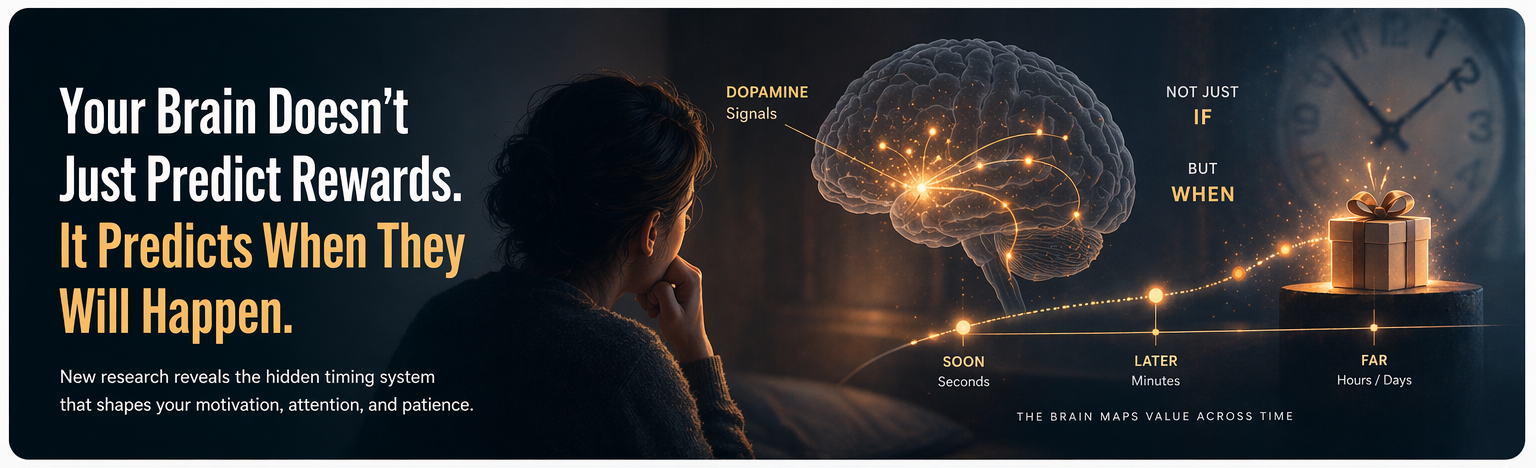
There is a subtle but powerful aspect of how the brain processes motivation that has only recently become clearer through advances in neuroscience, and it changes the way we understand attention, patience, and even everyday behaviors that seem unrelated at first glance, such as losing interest, becoming distracted, or preferring immediate rewards over delayed ones.
For a long time, the dominant view in neuroscience was that the brain’s reward system, driven largely by dopamine, was primarily concerned with predicting whether something rewarding would happen, and that this prediction alone was sufficient to explain why certain behaviors were reinforced and others were not.
However, recent research suggests that this view is incomplete in a way that has important implications, because the brain does not only predict if a reward will occur, but also when it will occur, and this temporal dimension appears to play a central role in how motivation is generated and maintained.
In other words, the brain is not simply asking whether something is rewarding.
It is asking whether it is worth waiting for.
Traditionally, dopamine has been understood through the framework of reward prediction, where neurons in areas such as the ventral tegmental area (VTA) respond to differences between expected and actual outcomes, signaling what is known as a prediction error.
When something is better than expected, dopamine activity increases.
When something is worse than expected, it decreases.
And over time, this signal helps the brain learn which actions are associated with positive outcomes.
This model has been extremely influential and remains a central part of how learning and motivation are understood.
But it leaves out something important.
It does not fully explain how the brain deals with time.
Recent findings show that dopamine neurons in the VTA do not simply encode the probability of future rewards, but also the precise timing at which those rewards are expected to occur, effectively creating a temporal map of anticipated outcomes across different time scales.
This means that different populations of neurons may respond to rewards expected in a few seconds, others to rewards expected in minutes, and others to rewards that are even further in the future, allowing the brain to represent not just value, but the temporal structure of value.
This discovery fundamentally expands the role of dopamine.
It is no longer just a signal about reward.
It is a signal about reward over time.
The inclusion of timing introduces a new dimension to how motivation is regulated, because the value of a reward is not fixed, but depends on when it is expected to occur.
A reward that is immediate is processed differently from a reward that is delayed, even if the objective outcome is the same, and this difference is reflected in neural activity.
The brain tends to prioritize rewards that are closer in time, but the recent findings suggest that this prioritization is not uniform, as different neural populations specialize in different temporal horizons, effectively allowing the system to weigh short-term and long-term rewards simultaneously.
This creates a flexible system, but also one that is sensitive to delay.
And this sensitivity has consequences.
One of the most immediate implications of this system is that impatience is not simply a psychological trait, but a reflection of how the brain evaluates delayed rewards.
If a reward is expected to occur far in the future, the corresponding neural signal is weaker or distributed differently, making it less compelling in the present moment.
This does not mean the reward is not valued.
It means it is not strongly represented now.
As a result, the brain may shift attention toward alternatives that offer more immediate reinforcement, even if those alternatives are objectively less valuable.
This is not a failure of rationality.
It is a consequence of how value is encoded over time.
This same mechanism helps explain why interest often declines, even in activities that were initially engaging, because as the brain becomes more familiar with an activity, the timing of expected rewards becomes more predictable, and the initial uncertainty that drove engagement is reduced.
At the same time, if the perceived rewards are spaced out or delayed, the system may begin to assign them less weight in the present moment, leading to a decrease in engagement even without a change in the activity itself.
In this sense, losing interest is not random.
It reflects a recalibration of value based on temporal expectations.
This process can be understood as a dynamic system:
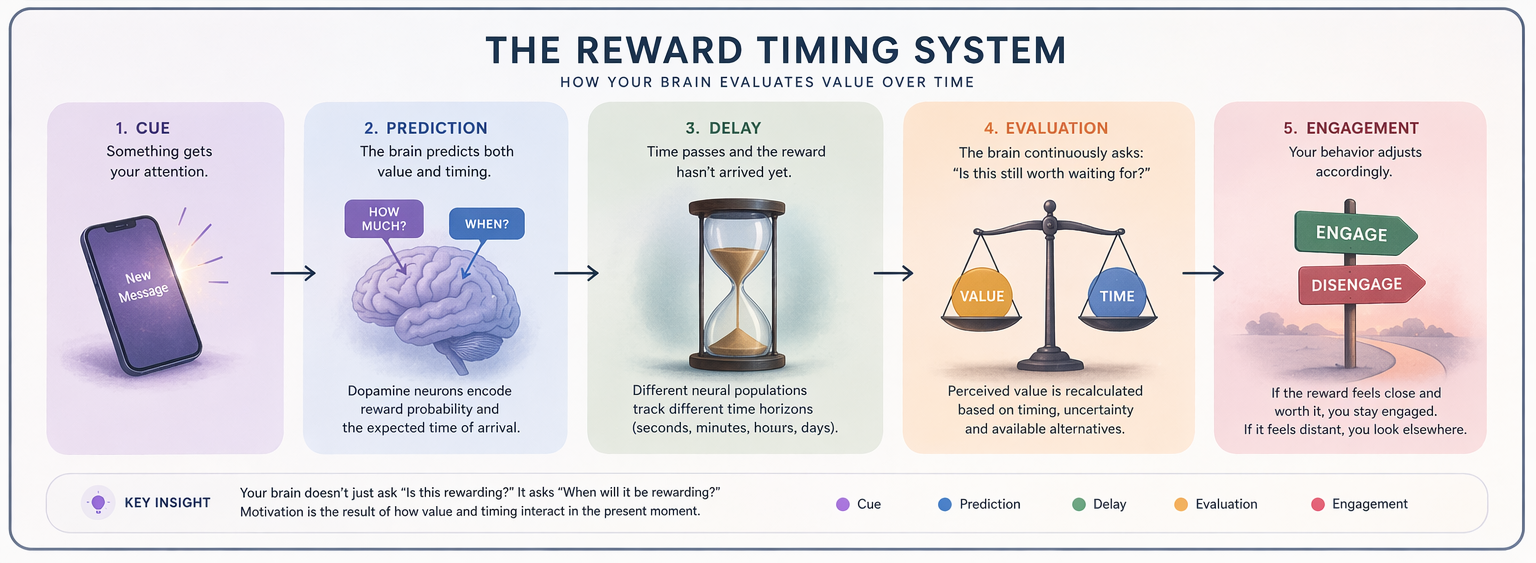
Cue
→ Prediction (reward + timing)
→ Delay
→ Evaluation (“Is this worth waiting for?”)
→ Engagement or disengagement
When the predicted reward is both valuable and temporally close, engagement is sustained.
When it is distant or uncertain, engagement weakens.
These findings suggest that motivation is not simply driven by how rewarding something is, but by how that reward is distributed over time and how strongly it is represented in the present.
This changes the way we think about effort, persistence, and even self-control, because it implies that what we experience as motivation is deeply tied to how the brain encodes future outcomes relative to the present moment.
In this framework, motivation is not a fixed trait.
It is a function of temporal valuation.
Additional recent research suggests that dopamine may also play a role in modulating behavior in real time, adjusting the intensity and direction of actions rather than simply encoding learning signals, which further complicates the traditional view and highlights the dynamic nature of the system.
This reinforces the idea that dopamine is not a static signal, but part of a continuously adaptive system that integrates multiple variables, including timing, effort, and context.
The idea that the brain predicts not only rewards but also their timing changes how we understand everyday experiences in subtle but important ways, from why we struggle to stay engaged in long-term goals to why immediate rewards feel disproportionately compelling.
You are not simply responding to what is rewarding.
You are responding to when it is expected to become rewarding.
And in that difference lies a large part of what shapes attention, motivation, and behavior.
Related reading: Why Your Brain Loses Interest